
Image source: shutterstock.com
For millions of Americans, the warehouse club membership card is a badge of financial savvy. The promise of buying bulk goods at near-wholesale prices seems like the ultimate hedge against inflation. Shoppers flock to Costco, Sam’s Club, and BJ’s, seduced by the prospect of cheap gasoline and the famous $1.50 hot dog combo. However, for many households—particularly smaller ones—the math of the warehouse club does not always yield a positive return on investment. The business model of these clubs is engineered to induce a specific type of spending behavior that can easily negate the savings on unit price, leading to a phenomenon where you save pennies on the ounce but lose dollars on the transaction.
The Break-Even Barrier
The first hurdle is the membership fee itself. Before you save a single dime, you start the year in the red. If a basic membership costs sixty dollars, you must save exactly that amount just to reach zero. If you save fifty cents on a gallon of milk, you need to buy one hundred and twenty gallons just to recoup your entry fee. Many casual shoppers fail to track their actual savings against this upfront cost, operating under the assumption that access equals savings. Unless you are a high-volume shopper or a strategic driver who maximizes the fuel perks, the membership fee often acts as a donation to the corporate bottom line rather than an investment in your pantry.
The “Treasure Hunt” Psychology
Warehouse clubs are intentionally designed without aisle signage to force you to wander. This layout strategy, known in the industry as the “Treasure Hunt,” exposes you to non-essential, high-ticket items like televisions, seasonal decor, and clothing. You walk in for rotisserie chicken and toilet paper, but you walk out with a kayak and a three-pack of cashmere sweaters. This impulse spending is the primary revenue driver for the club. If you save twenty dollars on groceries but spend two hundred dollars on unplanned merchandise, your budget has taken a significant hit, regardless of how cheap the eggs were.
The Perishable Peril
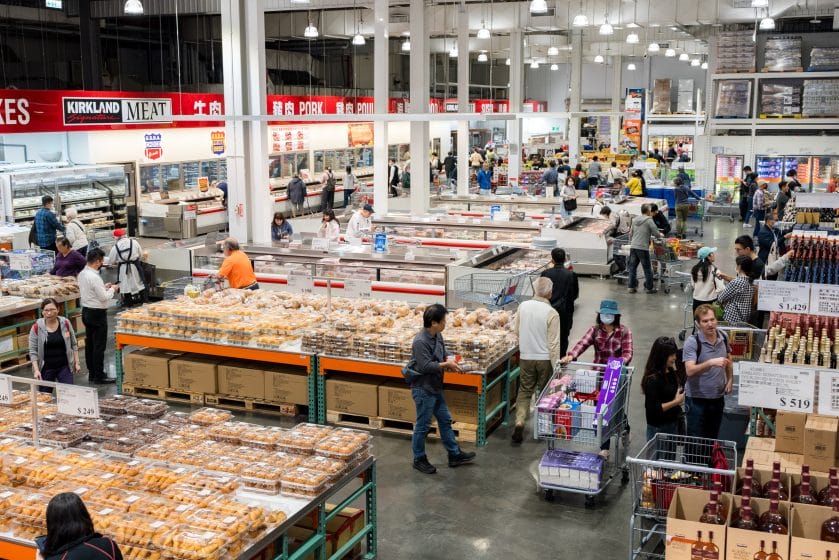
Image source: shutterstock.com
Bulk buying works beautifully for toilet paper and rice, but it is a financial trap for perishables. A five-pound clamshell of spinach offers an incredible price per ounce, but if your family only eats three pounds before the rest turns to slime, the price of the spinach you actually consumed skyrockets. The waste factor is the silent killer of warehouse savings. Throwing away huge portions of fruit, bread, or dairy because you could not consume them in time destroys the value proposition. You are essentially paying the store to haul trash to your own home.
The Cash Flow Constraint
Warehouse shopping requires significant liquidity. Spending $300 in a single trip to stock up on staples ties up cash needed for other bills. While the unit price is lower, the cash outlay is massive. For a family on a tight weekly budget, locking up fifty dollars in laundry detergent that will last six months is not always the smartest financial move.
The “Consumption Velocity” Effect
Having an abundance of a product subconsciously changes how you use it. When you have forty-eight rolls of paper towels in the garage, you tend to be more liberal with how many sheets you grab for a spill. When you have a gallon of shampoo, you use a larger dollop. This increased “consumption velocity” means you go through the product faster than you would if you bought the standard size. This nullifies the bulk discount. You are not saving money; you are simply using more product.
The Mathematical Tipping Point
Warehouse clubs offer undeniable value, but only for those who wield the membership with strict discipline. To win this game, you must stick to a rigid list. You must also avoid the center-store “treasure hunt” aisles, and realistically assess your household’s consumption rate. If you cannot consume the bulk pack before it spoils, or if the large receipt prevents you from paying other bills, the warehouse club is a luxury, not a savings strategy.
What to Read Next
Grocery Chains Test Membership Tiers That Combine Delivery and Coupons
Costco Is Cracking Down on a Popular Membership Perk, and Shoppers Are Furious
10 Kirkland-Brand Items From Costco That Are 100% Worth The Membership Fee
Warehouse Employees Face Overtime Surges Due to Seasonal Inventory Pressure